

Rohingya refugees have endured years of misery and violence in Bangladesh, but the ouster last month of Sheikh Hasina, the country’s authoritarian former prime minister, has given them new hope for the future.
About a million members of the stateless and persecuted Muslim minority live in a vast patchwork of Bangladeshi relief camps after fleeing violence in their homeland next to Myanmar.
In 2017, Hasina was praised by the international community for opening the border to an estimated 750,000 Rohingya who fled a Myanmar military crackdown that is now the subject of a United Nations genocide investigation.
But the years since have seen rampant malnutrition and regular gun battles in the camps, whose residents hope Hasina’s ouster will bring renewed attention to their plight.
“We and our children live in fear at night because of the shooting,” said Sonjida, 42, a Rohingya refugee who endured years of boredom, misery and violence in Bangladesh. AFP.
Shonjida teaches at one of the few informal learning centers set up for school children in her camp, giving her a disturbing insight into the multiple problems facing her community.
The centers can serve only a fraction of the camp’s families, whose refugee status excludes them from Bangladeshi schools, universities and the local labor market.
Many of its students are malnourished because a reduction in international aid has forced successive ration cuts.
And they are terrified by the sound of rival fighters fighting for control of the camps, with more than 60 refugees killed in clashes so far this year, according to local media reports.
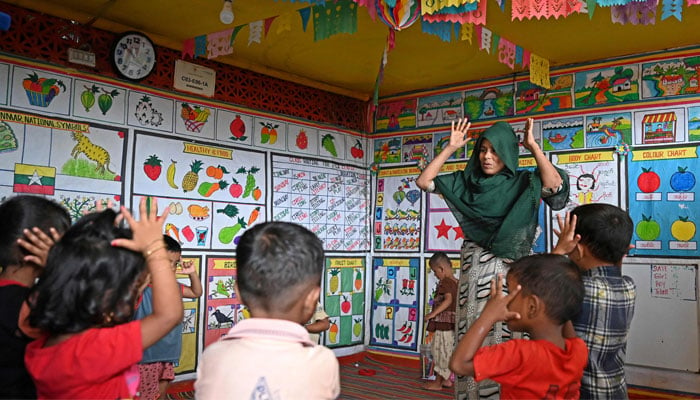
“We want peace and no more gunfire. We want our children not to be afraid anymore,” Sonjida said. “Now that the new government is in power, we hope it will give us peace, support, food and security.”
Years of misery, violence
Hasina was ousted last month in a student-led uprising that forced her into exile in neighboring India, moments before thousands stormed her palace in the capital Dhaka.
The revolution brought the curtain down on a 15-year rule marred by extrajudicial killings of opponents, restrictions on the press and a crackdown on civil society.
Her decision to welcome Rohingya fleeing Myanmar has earned her some diplomatic reprieve from Washington and other Western capitals, which have otherwise issued regular rebukes over abuses committed during her tenure.
But her government’s struggles to accommodate refugees in the following years have also been regularly criticized by rights groups.
It moved at least 36,000 Rohingya to the previously uninhabited and cyclone-prone island of Bashan Char to ease overcrowding in camps.
Many of those sent there said they were forced to go against their will, with one refugee describing their new home to Human Rights Watch as “an island prison in the middle of the sea.”
The desperate situation in the camps has also prompted thousands to embark on perilous sea journeys to find new refuge in Southeast Asian countries, with many drowning at sea.
The refugees refuse to return to their homes
Nobel Peace Prize laureate Muhammad Yunus, who heads a transitional government ahead of new elections, began his term last month pledging to continue supporting the Rohingya.
Many refugees said they had been encouraged by the first weeks of the 84-year-old’s administration.
“We saw on Facebook and YouTube that many of our community leaders had spoken to them and met with them,” said community leader Hamid Hossain, 48. AFP. “I’m more optimistic now.”
But Yunus also said Bangladesh needs “the continued efforts of the international community” to take care of the Rohingya.
This week he traveled to the United States and lobbied for more foreign aid for the group, with the State Department announcing nearly $200 million in additional funding after Yunus held a private meeting with President Joe Biden.
Yunus also called for rapid resettlement of the Rohingya in third countries, with the prospect of the refugees returning safely to their original homes looking slimmer than ever.
The Rohingya have suffered decades of discrimination in Myanmar, where successive governments have classified them as illegal immigrants despite their long history in the country.
Hasina’s government and Myanmar made several abortive plans to institute a repatriation program, opposed by refugees who did not want to return home without guarantees of their safety and political rights.
The security situation has deteriorated dramatically since last year. Rohingya-majority communities in Myanmar have become the site of intense clashes between the military and a rebel army fighting the country’s junta.
“There are killings there,” refugee Mohammad Johar, 42, said AFP. “How can we get back?”
a href=”https://www.geo.tv/latest/566025-rohingya-in-bangladesh-hope-for-renewed-attention-after-hasinas-ouster”>Source link


