
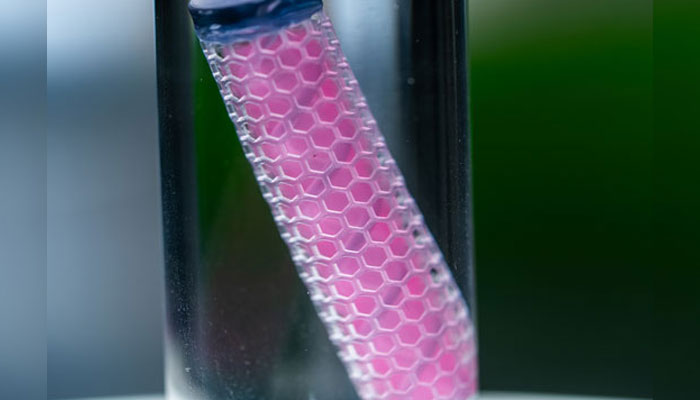
A team of scientists at Rice University has received $45 million in funding from the Healthcare Advanced Research Projects Agency to develop a new implant-based treatment system that could reduce cancer death rates by 50 percent.
The system, called “sense and response implant technology,” aims to improve the results of immunotherapy treatments for cancers that are usually difficult to treat.
With this technology, treating cancer could be as simple as a few taps on a mobile device, the New York Post mentionted.
“Instead of strapping patients to hospital beds, IV bags and external monitors, we will use a minimally invasive procedure to implant a small device that continuously monitors their cancer and adjusts the dose of their immunotherapy in real time,” said Omid Veiseh , an industrialist at the university and the principal investigator on the project, said in a statement.
The three-inch implant, or “hybrid advanced molecular regulator” (HAMMR), would deliver immunotherapy drugs to the patient in a “closed-loop” method, similar to diabetes treatments that use insulin pumps.
In addition, wireless communication will be used by rechargeable gadgets, “possibly with smartphones,” the researchers said KHOU 11.
However, researchers hope the implant will only be needed for short-term use – eradicating cancer in as little as 60 days.
“Cancer cells are constantly evolving and adapting to treatment,” said Dr. Amir Jazaeri, co-principal investigator and professor of gynecologic oncology at The University of Texas MD Anderson Cancer Center.
“However, currently available diagnostic tools, including radiological examinations, blood tests and biopsies, provide very rare and limited snapshots of this dynamic process. As a result, current treatments treat cancer as if it were a static disease,” continued his statement.
Instead, their device will speed up treatment by providing “real-time data from the tumor environment that can in turn guide more effective and tumor-informed new therapies” and by acting as both a cancer monitoring system and a administration of drugs.
“The technology is widely applicable for peritoneal cancers that affect the pancreas, liver, lungs and other organs,” said Veiseh.
The project’s name is THOR, which stands for “targeted hybrid tumor therapy,” and the research team is made up of experts from a variety of professions working at 20 facilities in seven states.
The effectiveness of the implant in treating recurrent ovarian cancer will be tested in the initial clinical study, and within five years, they want to begin conducting human trials.
Last year, Veiseh’s team demonstrated the effectiveness of the “drug factory” technology in mice, eradicating late-stage ovarian and colon cancer in six days.
They are now able to “build on that experience” with clinical trials, Veiseh said, with HAMMR as “the next iteration of this approach.”
a href=”https://www.geo.tv/latest/512357-researchers-working-on-implant-device-to-cure-cancer-with-mobile-app-in-60-days”>Source link



