

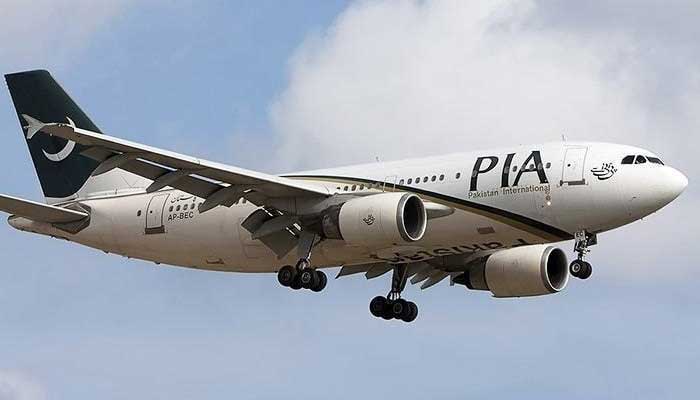
KARACHI: Experts have hailed the delayed privatization of Pakistan International Airlines (PIA) saying the move sends a strong signal to investors that the government is serious about shrinking its commercial footprint and tackling inefficiencies that have drained public resources for years. The News reported on Wednesday.
“The government will have to make sustained efforts to get out of business,” Uzair Younus, a Washington-based economic analyst, said in comments to the report.
He described the PIA transaction as a turning point, adding that other sectors, particularly energy, should follow. “Privatization and deregulation of the energy sector should be the first priority for 2026,” he said.
A consortium led by Arif Habib Corporation emerged as the top bidder on Tuesday for a 75% stake in the national carrier, offering Rs135 billion in what authorities hailed as a landmark moment.
The auction marked Pakistan’s first major privatization in nearly two decades and comes amid pressure to reform loss-making state-owned enterprises under a $7 billion International Monetary Fund (IMF) program.
Arif Habib raised his bid from Rs115 billion to Rs135 billion after the Lucky Cement Limited-led consortium raised its earlier bid of Rs101.5 billion to Rs134 billion in the second round of the open auction.
Consortiums Arif Habib and Lucky Cement advanced to the open auction stage after placing bids above the Rs 100 billion benchmark, while private airline Airblue pulled out of the bidding after bidding Rs 26.5 billion.
Government officials said that of the amount paid for the 75% stake, 92.5% of the proceeds will be directly invested in PIA, while the remaining 7.5% – amounting to 10.12 billion rupees – will be transferred to the federal government. The 25% stake retained by the government has been described as a valuable asset and successful bidders will have the option of acquiring it at a later stage or allowing it to remain with the state, under the privatization framework.
Losses from state-owned enterprises have long limited Pakistan’s fiscal space, limiting spending on health, education and social protection. Mohammad Sohail, managing director of brokerage Topline Securities, said the sale of PIA marked Pakistan’s first major privatization in 19 years and reflected renewed investor confidence.
“The offer price exceeded expectations,” Sohail said, pointing to the competitive process as evidence that investors see value in the airline’s future. “This move sends a strong message to business about the government’s seriousness in tackling public sector inefficiencies.”
Sohail said most previous privatizations had delivered value to both consumers and the state, arguing that the government’s role should be to regulate markets rather than run commercial enterprises.
That assessment is hotly disputed by critics, who say Pakistan’s privatization record has been marred by weak governance, corruption and the entrenchment of private monopolies.
Ammar Ali Jan, an academician and general secretary of the Haqooq-e-Khalq Party (HKP), said that in the last three decades, privatization had failed even by the standards of global financial institutions. Citing estimates by the Asian Development Bank, he said more than 70% of Pakistan’s privatizations are not meeting set targets.
“This is not a left-wing critique,” he said. “Privatization in the 1990s and 2000s created cartels, encouraged nepotism and hollowed out public institutions.”
He argued that PIA’s decline cannot be attributed solely to overwork, a common justification for privatization. Instead, he pointed to years of mismanagement by political appointees and private sector professionals hired by the state. At the same time, he said, private airlines benefited from government subsidies as PIA deteriorated.
He also questioned why some state institutions that serve elites continue to function effectively while mass public services are collapsing. “It’s not just PIA,” he said, pointing to Pakistan Railways, the Pakistan Telecommunication Corporation and public education as examples of long-term institutional decay without accountability.
In his comments to Geo Newsformer adviser to finance minister Dr Khaqan Najeeb praised the PIA deal and said it was different from previous attempts.
“Privatization has always been an essential micro-economic reform for Pakistan. After 19-20 years, it is a positive step that we have successfully privatized a major entity like PIA. This required balance sheet clean-up, off-loading and incentives to make the deal sustainable. Losses,” he explained.
Jan cautioned that asset sales cannot substitute for a long-term industrial strategy. “A report by the United Nations Development Program estimates that $17.4 billion in subsidies and benefits are funneled annually to elite groups, more than 90 percent of them in the private sector.”
“There is no discussion of how to do land reform or increase taxation for the landowning elite, both urban and rural. No discussion of how to deal with the sugar mills and all the cartels in different sectors of the economy. The only thing that is being cut is the public sector.”
“Without an industrial plan, this is just delaying the problem,” the HKP leader said, comparing privatization-based reforms to repeated IMF bailouts. “Selling assets, minerals or strategic location cannot sustain the economy in the long run.”
a href=”https://www.geo.tv/latest/641193-pia-privatisation-reflects-govts-seriousness-to-shrink-commercial-footprint-experts”>Source link


