
CONSTANTINOPLE:
Pakistani and Turkish scholars and academics have launched joint projects to “solve common problems” using emerging technologies, including artificial intelligence (AI).
The joint projects will be carried out under an agreement between the Pakistan Institute of Engineering Sciences and Technology Ghulam Ishaq Khan (GIKI) and Ondokuz Mayis University in Turkey’s Black Sea province of Samsun.
In January, the two sides effectively signed a memorandum of understanding (MoU) which resulted in the first official visit to the Turkish university by Masroor Hussain, head of GIKI’s Department of Computer Engineering and Data Science.
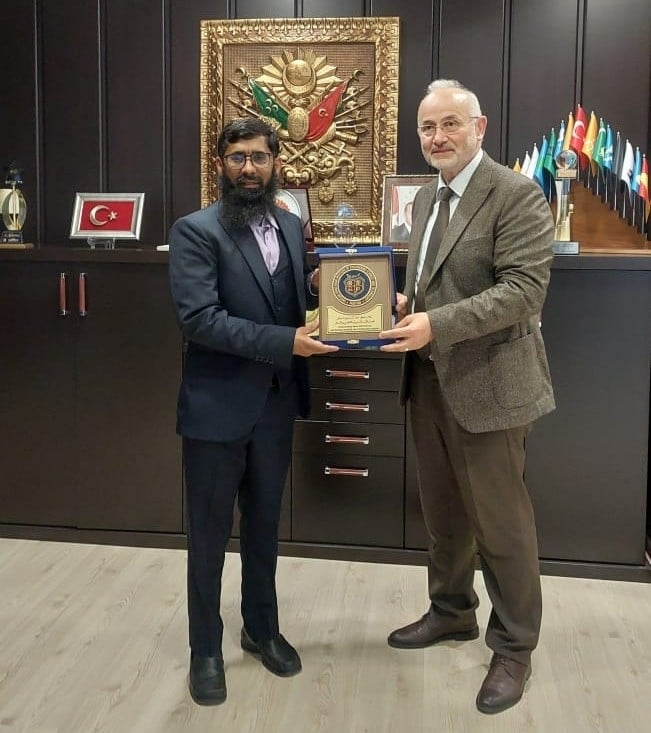
Prof. Masroor Hussain of Ghulam Ishaq Khan Institute of Engineering Sciences and Technology with Prof. Dr. Yavuz Unal, Chancellor of 19 Mayis University, Samsunda. PHOTO: ANADOLU AGENCY
“During this visit, the two institutions identified four to five potential collaborative projects leveraging artificial intelligence in computing and agricultural engineering,” Hussain said. Anatolia by phone.
The project of joint collaboration between Pakistani and Turkish academics and scientists was initiated by Agha Adel Saadat, an American of Pakistani origin.
Aga, along with two other friends, had visited several cities and provinces in Turkey before arriving at the May 19 University to lay the foundation for university cooperation.
“This partnership,” emphasized Hussain, “offers us exciting opportunities for international collaboration and the development of commercially viable solutions to address local challenges.”
Talking to you Anatolia from Samsun, Turkey, Ilkay Erken, director of international partnerships at Ondokuz Mayis University, said the MoU was an “umbrella protocol that covers everything.”
“Student and faculty exchanges in the departments … as it is important for us to get experience from them (Pakistan) and share our experiences with them,” said Erken, a trained historian.
Erken said: “We are planning to go for exchange of students and academic staff from the next academic session in September and we expect some results from next year.”
From technology to cultural ties
US-based Agha said the digital age “has connected us … in understanding cultures and traditions”.
“While Asia focuses on road and rail connectivity, people-to-people connections are vital. Collaboration in science and technology is a powerful way to achieve this,” Agha explained.
Emerging technologies allow Pakistani and Turkish academia to “collaborate to solve common problems,” he said.
According to Hussain, the Pakistani scholar, the collaboration will culminate in the development of Large Language Models (LLMs).
“It enables seamless digital translation between Urdu and Turkish (languages),” Hussain said.
“These LLMs will bridge the language barrier, which is the main barrier we are currently facing,” he concluded.
Agha agreed and said, “This collaboration will not only address common challenges, but also strengthen cultural and academic ties, promoting a more integrated and harmonious regional community.”
Also Read: Pakistan, Turkey set $5 billion trade target
The two sides expect their projects to be funded by the universities, in addition to support from the Scientific and Technological Research Council of Turkey (TUBITAK) and the Pakistan Science Foundation.
On why the Turkish university located along the Black Sea and the Pakistan Institute were chosen for cooperation, Agha said: “The connection between the Black Sea region and Pakistan is limited, but the people are hospitable and share cultural values with Pakistan”.
“This made it easy to choose Ondokuz Mayis University in Samsunda.
“Turkey and Pakistan have so many cooperative initiatives at the government level, but expanding this cooperation at the university level will accelerate scientific research and help the local manufacturing industry to make commercial products using this research,” he added.
Erken said the partnership with the Pakistani university “helps us remember shared historical stories” of the two peoples.
Aga said he and his friends are working to expand similar joint projects with universities in Central Asia.
“Initially, we are working with some friends in Uzbekistan,” he said.
a href=”https://tribune.com.pk/story/2467993/pakistani-turkish-academics-to-solve-common-problems-using-artificial-intelligence”>Source link


