
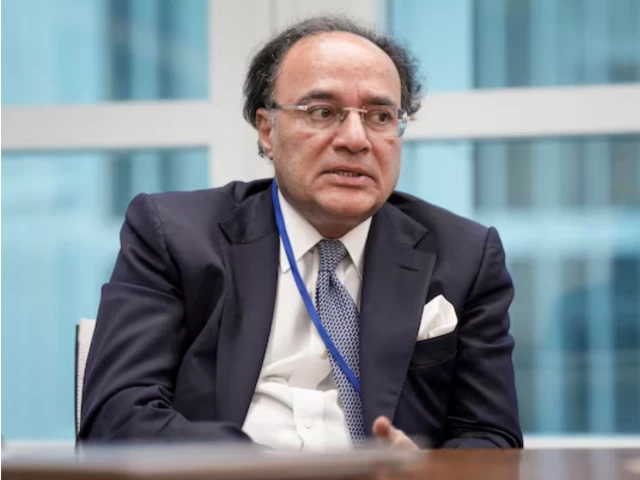
Finance Minister Muhammad Aurangzeb speaks during an interview with Reuters at the 2025 IMF/World Bank Annual Spring Meetings in Washington, DC, US, April 25, 2025. Photo: Reuters/ File
KARACHI:
Finance Minister Muhammad Aurangzeb, reflecting on the prospects for improving philanthropy through policy and tax structure improvements, said the emerging Pakistan Social Impact Financing Framework, a new initiative under the Prime Minister’s Office, aims to mobilize public, private and philanthropic capital for measurable social outcomes.
Speaking at the Corporate Philanthropy Awards 2025, organized by the Center for Philanthropy Pakistan (PCP), he said Pakistan’s corporate giving reached a record Rs 25.44 billion in 2023 and could double if the government undertakes meaningful policy and tax reforms to encourage structured giving and simplify compliance. “The corporate offering of Rs 25 billion is a great milestone,” he said.
Aurangzeb said the government is modernizing development finance through the new framework, which seeks to directly link social spending to measurable outcomes. He said the initiative represents a shift from traditional grant-based aid towards results and impact-based financing to ensure that every rupee achieves tangible results.
“Rather than focusing on blanket spending, we’re moving towards results-based and impact-based funding,” he said. “This requires blending public, private and philanthropic capital into coherent, results-driven structures.”
He announced that one of the key projects under the framework will be Pakistan’s first Skills Impact Bond, developed with the British Asian Trust and the National Vocational and Technical Training Commission (NAVTTC).
“The Skills Impact Bond is being launched to promote skills development and sustainable living,” he said. “It will move us away from relying solely on traditional bank financing and allow us to leverage the capital markets to raise finance for social causes.”
Aurangzeb added that the British Asian Trust partnership brings global expertise to the program, helping Pakistan pioneer market-based social investment models that align philanthropic giving with long-term economic outcomes.
PCP’s Corporate Philanthropy Report 2023 revealed that the contribution of Pakistan’s corporate sector was the highest in the two decades since PCP began tracking corporate giving. Public listed companies contributed Rs 18.23 billion, followed by public unlisted companies with Rs 3.28 billion and private limited companies with Rs 3.93 billion.
Despite the record numbers, Aurangzeb and several experts pointed to policy gaps, complicated tax laws and regulatory inadequacies that continue to constrain Pakistan’s philanthropic ecosystem.
Pakistan’s tax code offers limited incentives for charities, and the nonprofit certification process remains slow and cumbersome. The minister said these issues need to be addressed to enhance transparency and accountability.
“Efficiency is required at all ends,” he said, referring to bureaucratic obstacles. “We need to make it easier for both donors and nonprofits to operate, while ensuring credibility and oversight.”
“Philanthropy is not just an act of charity, it is an expression of our national identity,” he said. “Help build a more compassionate and inclusive Pakistan.”
He reaffirmed the government’s commitment to working with PCP and the private sector to promote a structured culture of giving. “You guide, connect and recognize those who build with purpose and responsibility,” he said. “The Government stands with you as a trusted partner – fully committed to supporting your efforts to shape a transparent, efficient and sustainable philanthropic ecosystem.” PCP Chairman Zaffar A Khan (SI) also addressed the gathering, stressing that with proper facilitation, the corporate and non-profit sectors can significantly expand their contribution to the social development of Pakistan.
a href=”https://tribune.com.pk/story/2578422/results-based-philanthropy-urged-as-giving-hits-rs254b”>Source link



