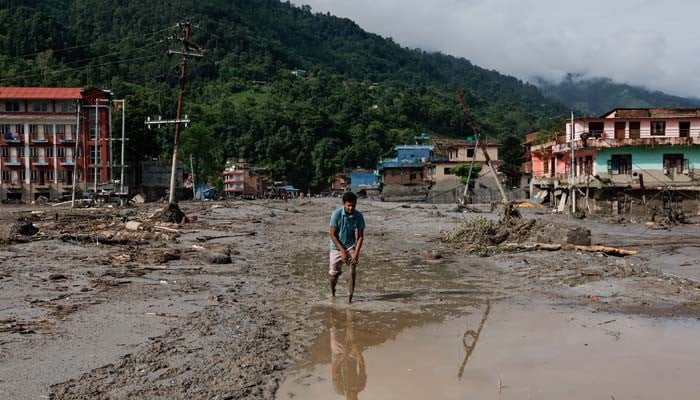
Rescuers in Nepal used helicopters on Thursday to search for hundreds still missing after a wall of mud and rock collapsed into a river on the Himalayan border with China’s Tibet, sending catastrophic floods through towns and valleys (Geo News).
162 people have been confirmed killed.
The missing
Nearly 1,500 people are missing across Nepal and Tibet, including more than 700 foreigners, authorities said on Thursday.
In Nepal alone, 826 people are missing, of whom almost 500 are foreign nationals. Among the missing tourists, from more than two dozen countries: 177 Indians, 63 Americans, 34 Australians, 33 Britons and 25 Canadians.
Malaysia’s foreign ministry said 55 of its nationals were uncontactable, without official confirmation of casualties.
“This will go up, as we have resumed the search and more bodies are expected to be recovered,” police spokesperson Abi Narayan Kafle told Reuters.
Why the toll will rise
The figures above describe a disaster still being counted rather than one being assessed.
A confirmed death toll of 162 against nearly 1,500 missing is the shape of an event where the recovery has barely begun. In flood and landslide disasters of this kind the missing are, over subsequent days, largely reclassified rather than found.
The proportion of foreigners is unusual and reflects where it struck: this is peak trekking season in a region that draws visitors from across the world.
What happened
The collapse sent water and debris down through Trishuli in Nuwakot district and beyond.
Helicopters have been dropping aid as well as searching. The cause of the collapse has not been established in the reporting available, though such events in the Himalaya are commonly associated with glacial lake outbursts and with monsoon saturation of unstable slopes.
In the region
Pakistan’s own monsoon has been severe, with flooding in Battagram and Lower Dir and a flood alert on Rawalpindi’s Nullah Lai earlier this month. Prime Minister Shehbaz Sharif has ordered financial assistance for affected families.