
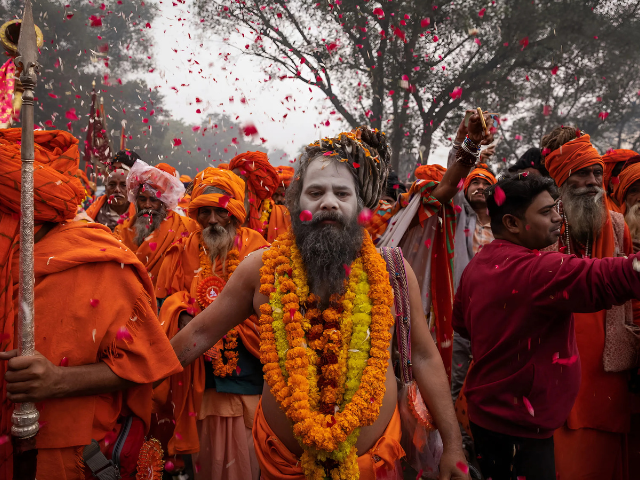
The world’s largest religious gathering, the Maha Kumbh Mela, began in India, drawing millions of Hindu worshipers to the banks of the Ganges in Prayagraj, Uttar Pradesh.
The festival, which takes place every 12 years, is particularly important this year as it marks the Maha Kumbh Mela, a major event that takes place only once every 144 years.
The festival is expected to attract over 400 million people, the largest crowd in the event’s history, and will run for 45 days, ending on February 26.
Prayagraj is considered one of the holiest places for Hindus due to its location at the Triveni Sangam, at the confluence of the Ganges, Yamuna and the mythical Saraswati rivers. Devotees believe that immersing themselves in the waters will purify their souls.
The festival includes several shahi snans (holy bathing days), where participants believe the act cleanses them spiritually.

Photo: @devdxb on Instagram
The origins of the Kumbh Mela are rooted in the Hindu legend of Samudra Manthan, or the churning of the ocean.
According to legend, Lord Vishnu dropped drops of the elixir of immortality from his urn at four points on Earth, now believed to be the cities of Prayagraj, Haridwar, Ujjain and Nashik, which host the Kumbh Mela on a rotating basis.

Photo: @devdxb on Instagram
This year’s event is particularly grand, with significant political overtones. The festival is considered a symbol of Hindu unity, and under the current Bharatiya Janata Party (BJP) government, led by Prime Minister Narendra Modi, the scale of the festival has grown, both in terms of religious significance and political symbolism.
Uttar Pradesh Chief Minister Yogi Adityanath, a BJP member and Hindu monk, has spent over 70 billion rupees on infrastructure and sanitation for the festival.
This year’s celebration is expected to be the most expensive to date, with government funds allocated to make the event a success.
While the Kumbh Mela is traditionally a celebration of Hinduism and unity, this year’s festivities have also sparked controversy.
Reports have emerged that Muslim vendors were banned from setting up stalls for the first time, and Muslim taxi drivers were reportedly instructed not to take passengers from Hindu pilgrims. These developments have sparked concerns about the potential for sectarian tensions.
Senior festival priest Mahant Durganand Brahmachari called for peaceful coexistence, condemning any attempt to divide the community along religious lines.

Photo: @devdxb on Instagram
Technological innovations have also been introduced to improve the organization and security of the event. The Kumbh Mela mobile app, which includes an AI-powered chatbot in 11 languages, will help pilgrims navigate the vast festival grounds, spread across 15 square miles.
To address the issue of lost pilgrims, each attendee will be given a radio frequency wristband for tracking purposes. In addition, security will be enhanced by the use of thousands of drones, both underwater and in the air, and a light show featuring over 2,000 drones will depict stories from Hindu mythology.
Despite the challenges, the Maha Kumbh Mela is expected to continue to grow in importance, both as a religious and cultural spectacle, attracting millions of participants from around the world.
a href=”https://tribune.com.pk/story/2521824/maha-kumbh-mela-festival-begins-in-india-after-144-years”>Source link


