
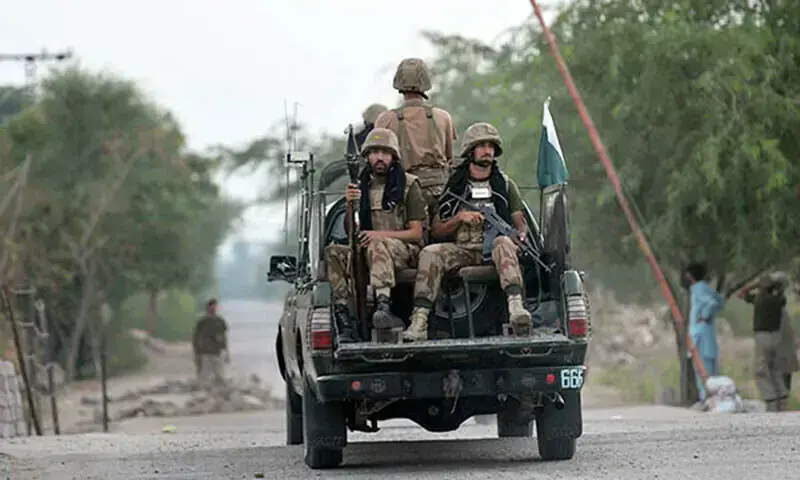
The military says 11 militants were killed in two operations in Balochistan (Dawn).
The two engagements
| Date | District | Killed | |—|—|—| | 6 September | Kharan | 8 | | 7 September | Washuk | 3 |
In Kharan, ISPR says militants “attempted to establish a roadblock” and disrupted traffic; security forces “promptly intercepted and engaged the terrorists, whereby, killing eight Indian sponsored terrorists.”
In Washuk the following day, an operation described as “deliberately planned” ended, in the statement’s words, with three militants “sent to hell.”
What was recovered
2.9 tonnes of explosives, which ISPR says were intended for making improvised explosive devices. No own casualties were reported.
The naming
ISPR attributes both engagements to Fitna al Hindustan, the term the military uses for Baloch separatist groups it describes as Indian proxies.
That attribution is a claim, not an established fact, and it is worth stating plainly what it does and does not rest on. The military has not published the evidence linking these particular men to Indian sponsorship. India denies the charge. This newspaper reports the designation because it is what the statement says, not because we can verify it.
What officials said
President Asif Ali Zardari: “Operations will continue until the complete eradication of terrorists belonging to Fitna al Hindustan network.”
Interior Minister Mohsin Naqvi: “The brave sons of the security forces are a source of pride for the nation.”
Not the same as the KP figures
These are Balochistan operations and are separate from the Khyber Pakhtunkhwa engagements this newspaper reported on 6 September, when ISPR announced 21 killed and stated explicitly that those were distinct from 15 announced earlier.
We make the point because the running totals in these statements are easy to double-count, and we have had to disentangle them twice in the past week.
What is not established
No identities have been released for any of the 11. No independent verification of the operations, the casualty figures or the explosives recovery is available, and Balochistan’s access restrictions mean there is unlikely to be any.
The 2.9-tonne figure is significant if accurate — it is a bulk logistics quantity rather than a field cache — but nothing has been published about where it was stored or how it was moved.
[Image: AFP/File via Dawn]



