
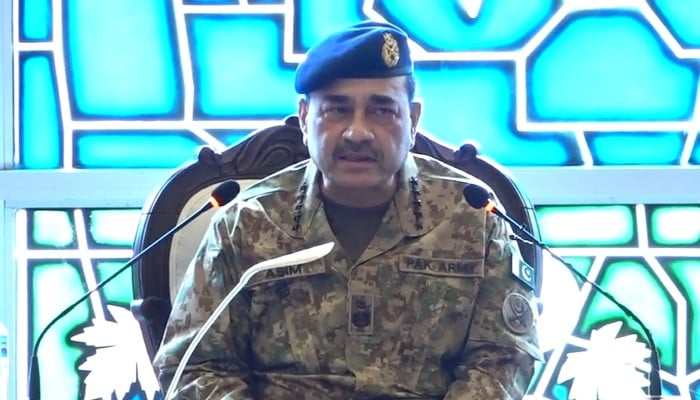
Chief of Defence Forces and Chief of Army Staff Field Marshal Syed Asim Munir has pledged that hostile elements’ “inimical designs” aimed at obstructing Balochistan’s development will be defeated through a decisive response, the Inter-Services Public Relations directorate said on Friday (Geo News).
The remarks came during an interaction with notables and the political leadership of the province.
What he said
Munir said the present and future of Balochistan and Pakistan were “one and forever”, according to the ISPR statement, and described the province as blessed with talented, resilient, patriotic and proud people.
He named two threats in the military’s current vocabulary — Fitna al-Khawarij and Fitna al-Hindustan — describing both as foreign-sponsored proxies employed by hostile elements to destabilise Balochistan, obstruct its development and drive a wedge between the state and its people.
He also stressed the need to counter hostile propaganda, and lauded the role of the province’s notables in promoting peace.
The economic argument
A substantial part of the address was about economics rather than security.
Munir said a clear national narrative and enduring peace and stability were fundamental to unlocking Balochistan’s true economic potential, attracting investment, and translating its human and natural resources into tangible prosperity.
On youth, he said there was no dearth of talent or opportunity among young people in the province, describing them as the most vibrant and promising segment of society, and said empowering them and giving them opportunities to contribute to national progress remained central to sustainable development.
The setting
The interaction took place against a continuing security tempo in the province. Five militants were killed in an intelligence-based operation in Panjgur on Thursday under Operation Radd-ul-Fitna 3, and six people were killed in an explosion at an orchard in Mastung on Friday.
Balochistan accounted for 34 per cent of Pakistan’s violence-related fatalities in the second quarter of 2026, according to the Centre for Research and Security Studies — 265 deaths, against 475 in Khyber Pakhtunkhwa.
The account of the meeting above is drawn entirely from the ISPR statement, which is the only source for what was said.



