

The world’s largest iceberg, A23a, is drifting north from Antarctica, potentially threatening South Georgia, a British Overseas Territory in the South Atlantic.
The massive iceberg, which spans 3,672 square kilometers (1,418 square miles), has raised fears of ecological disruption and risks to shipping lanes.
Scientists warn that if A23a lands on the South Georgia continental shelf, it could block access to critical feeding grounds for seals and penguins, which depend on the island’s rich marine resources for survival.
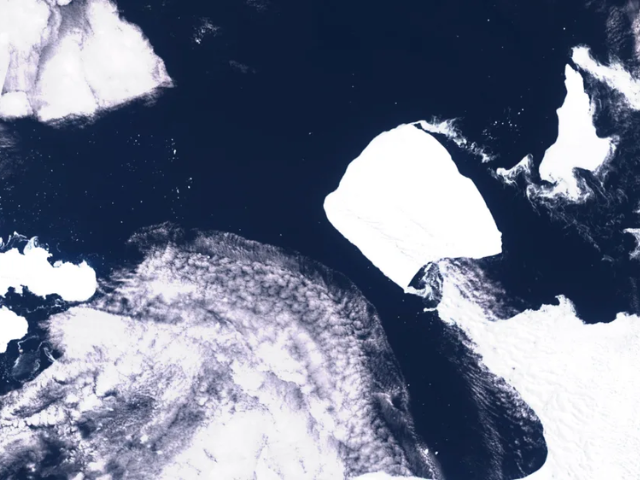
A satellite image of A23a in Antarctica taken in November 2023. European Union/Copernicus Sentinel-3/Handout/Reuters
“If this happens, it could seriously impede access to feeding grounds for the wildlife – seals and penguins in particular – that breed on the island,” said Andrew Meijers, an oceanographer at the British Antarctic Survey.
The iceberg, slightly smaller than Rhode Island and more than twice the size of London, was born from Antarctica’s Filchner-Ronne Ice Shelf in 1986. For more than 30 years, it remained grounded at the bottom of the Weddell Sea until it shrank enough to break free .
It then drifted with the ocean currents and became stuck again in a Taylor column – a spinning eddy of water caused by underwater mountains.
In December 2024, the iceberg finally broke free and began moving toward warmer waters. While scientists initially expected it to break into smaller fragments, recent satellite images show that it has retained its structure.
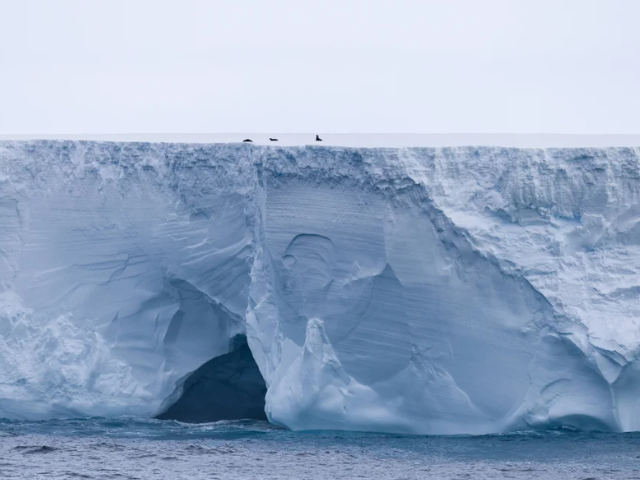
The world’s largest iceberg, A23a, could be headed for the British overseas territory of South Georgia. Jean-Felix Fayolle/Zeppel/SIPA/Shutterstock
Simon Wallace, captain from the South Georgia government boat Lighthousedescribed the iceberg as a major threat to shipping routes. “Icebergs are inherently dangerous. Larger ones are easier to detect and avoid, but smaller fragments are harder to detect and can be just as dangerous,” he told CNN.
Wallace warned that the debris could fill South Georgia’s bays and fjords, creating navigational challenges for boats.
Mark Belchier, director of fisheries and environment for South Georgia and the Sandwich Islands, also expressed concern about the potential impact on shipping and fishing activities in the area.
“While they are common in South Georgia, they can cause problems for shipping and fishing vessels,” Belchier said.
Scientists believe that the iceberg’s detachment from the ice shelf was part of its natural growth cycle and was not directly caused by climate change. However, global warming is leading to significant changes in Antarctica, accelerating ice loss and contributing to sea level rise.
South Georgia, a biodiversity hotspot, is home to one of the largest marine protected areas in the world. While any impacts from the iceberg are expected to be localized and temporary, the situation highlights the delicate balance of the region’s ecosystem.
Experts are closely monitoring the iceberg’s trajectory to determine whether it will drift into the open South Atlantic or stick to the continental shelf near South Georgia.
The British Antarctic Survey uses satellite images and ocean current models to predict its movements in the coming weeks.
A23a’s move highlights the growing challenges Antarctic icebergs pose to ecosystems, marine industries and global climate stability.
As the world grapples with the effects of climate change, events like this serve as a stark reminder of the interconnectedness of natural and human systems.
a href=”https://tribune.com.pk/story/2524250/fears-grow-as-worlds-largest-iceberg-drifts-towards-south-georgia”>Source link



