

Extreme weather conditions killed at least 30 people in Beijing after a one -year rain declined to less than a week, forcing more than 80,000 people to relocate, destroying the roads and cutting off power and communications to more than 130 villages.
Hundreds of flights and several train services have been delayed or suspended as thunderstorms culminated on Monday night, stretching the capital’s disaster management capabilities and urging some experts to call the “rain” trap.
Most of the rain converged on the north wall of Beijing near the Great Wall, with at least 28 deaths reported in the Miyun area and two in Yanqing, Xinhua said. The State News Agency did not say when or how the deaths occurred.
“The flood came at a time, you just didn’t have a buffer,” said Zhai, 33, who manages a grocery store in Miyun, now a disaster zone in collapsing bridges, pipelines and broken pipes.
He showed Reuters the signs left behind as the flood waters declined. They had increased to 1.5 meters (4.92 feet), dipping its store for hours and destroying food and drink stocks.
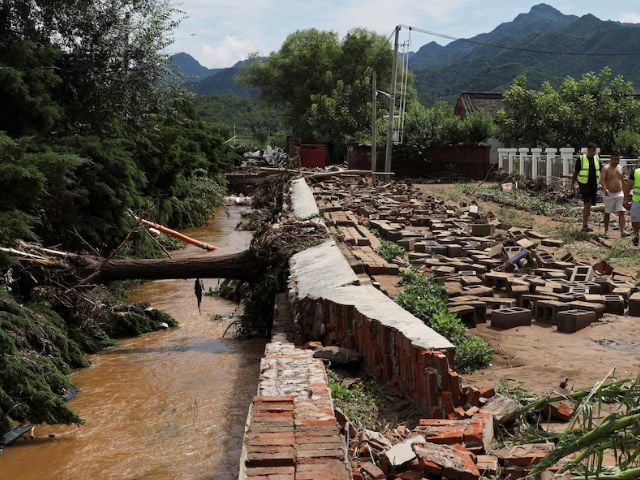
Men walk beyond the fallen trees and damaged corn plants, as heavy rainfall flooded the area in the Miyun area of Beijing, China, July 29, 2025.
Liu, who owns a nearby restaurant, was on the brink of tears as he looked at the subversive stools and mud -covered tables in her restaurant.
Large devices such as Fridges had sat down for hours and probably suffered damage, Yang’s husband said, estimating the damage to more than 100,000 yuan ($ 14,000).
‘Extremely disastrous’
The heavy rains began on July 23 and culminated in Beijing and the surrounding provinces on Monday, with Miyun experiencing rainfall up to 573.5 mm (22.6 inches) – the levels of local media described as “extremely devastating”. The average annual rainfall in Beijing is about 600 mm.
The most intense thunderstorm occurred on Saturday in Hilly Huairou, Beijing, where 95.3 mm of rain fell in one hour.
“The cumulative amount of rainfall was extremely high – reaching 80-90% of the annual total in just a few days in some areas,” said Xuebin Zhang of the University of Victoria in Canada and CEO of the Pacific Consortium.
“Very few systems are designed to handle such a strong volume of rain in such a short time,” Zhang said.
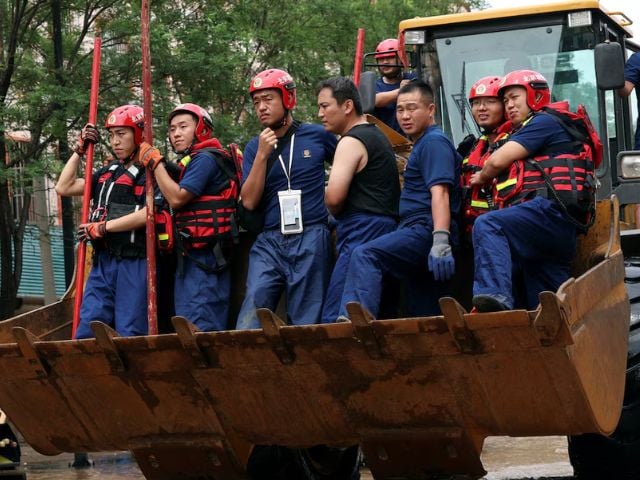
Rescue workers lead to a front loader as they make their way through a flooded road, after heavy rainfall in the Miyun area of Beijing, China, July 29, 2025.
Local topography – mountains to the west and north – “trapped” the liquid air and forced it up, enhancing the flood, he said.
China usually north has seen rains in recent years, with some scientists linking it to global warming.
In the summer of 2023, heavy rain and floods killed at least 33 people in Beijing. Rainfall in Xingtai in the neighboring province of Hebei exceeded 1,000 mm in two days – twice the annual average.
‘The flood is still coming’
The heavy rain also hit Hebei province and the town of Tianjin near Beijing.
In Hebei, eight people were killed as a landslide hit a village on Monday after the area was raining six months on the weekend. Four remained missing.
In two Tianjin villages on Monday, only the houses’ roofs were visible, Central Central Television (CCTV) said.
The Ministry of Emergency Management said the disaster relief situation was “complex and serious”.
Residents demanded faster attempts to rescue positions on the Weibo social media platform.
“The flood is still coming and there is no power or signal yet. And I can’t get in touch with my family!” A Weibo user wrote on Tuesday morning.
a href=”https://tribune.com.pk/story/2558492/extreme-weather-kills-30-in-beijing-as-years-rain-falls-in-a-week”>Source link


