

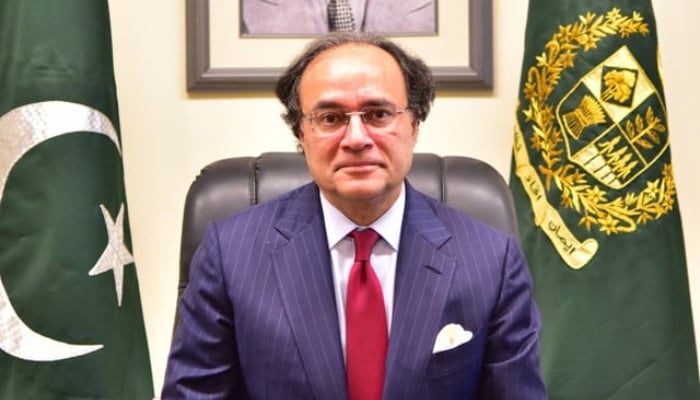
- Macroeconomic stability, reforms restore confidence: Aurangzeb.
- FinMin says fiscal discipline is replacing the consumption model.
- He says that including climate resilience supports long-term sustainability.
Federal Finance and Revenue Minister Muhammad Aurangzeb said Pakistan has reached a turning point, with macroeconomic stability, ongoing reforms and policy continuity restoring confidence and steering the economy towards export-led, long-term growth.
However, in an interview with USA Todaythe finance czar pointed out that economic growth of 2.7% in the previous financial year, while positive, is insufficient to absorb the needs of a rapidly growing population.
The minister said macroeconomic stability opens up new horizons for domestic and global investors and positions the country for sustainable, long-term economic growth.
He said this transition has been enabled by macroeconomic stabilization, easing inflation and improving external balances, with the government driving export-led, productivity-led growth through structural reforms, maintaining reform momentum despite challenges and actively encouraging global investment in emerging opportunities in agriculture, minerals, technology and climate resilience.
Aurangzeb emphasized that Pakistan entered fiscal year 2025 from a position of renewed strength, characterized by macroeconomic stability, improving external balances and a firm commitment to structural reforms.
He noted that, for the first time in several years, Pakistan achieved both a primary fiscal surplus and a current account surplus, marking a decisive shift from the cycle of recurring deficits. Strong remittance inflows have played a critical role in supporting this recovery, while inflation has fallen sharply from a peak of 38% to single digits.
“Sustainable development remains the central challenge”
Senator Aurangzeb emphasized that while macroeconomic stabilization is an essential foundation, sustainable development remains the central challenge.
Drawing lessons from the past, he highlighted that Pakistan is consciously moving away from a consumption and debt-driven growth model towards an export-led strategy. The current budget, he explained, reflects this shift through structural reforms in taxation, energy pricing and state-owned enterprises, alongside far-reaching tariff reforms aimed at dismantling decades of protectionism and boosting global competitiveness.
He emphasized that Pakistan is aligning its economic strategy with changing global demand patterns, identifying information technology services, textiles and agricultural exports as key sectors with strong potential. He noted that IT exports have already crossed four billion US dollars and could double within five years with sustained regulatory clarity and infrastructure development.
Efforts are also being made to simplify tax regimes for exporters and reduce bureaucratic hurdles in order to boost long-term productivity and competitiveness.
Pakistan’s future depends on challenges beyond fiscal numbers
Addressing the broader reform agenda, Finance Minister Aurangzeb said privatization of state-owned enterprises, tariff liberalization and restructuring of the power sector are designed to address deep-rooted inefficiencies that have historically plagued public finances.
These reforms, he said, are part of a longer-term vision, echoing the World Bank’s assessment of Pakistan’s potential “East Asian moment”.
He referred to the ten-year Country Partnership Framework with the World Bank, the first of its kind, which emphasizes economic reform alongside climate resilience and population management.
The federal minister also emphasized that Pakistan’s future depends on addressing existential challenges beyond fiscal indicators. Population growth, climate change, child stunting, learning poverty and the exclusion of girls from education were identified as critical issues to be addressed to ensure the country’s long-term productive capacity.
He emphasized that increasing women’s participation in education and the workforce is both a social imperative and an economic necessity.
On climate resilience, he highlighted Pakistan’s engagement with multilateral partners to strengthen preparedness against increasingly frequent floods and droughts.
“Discipline, consistency and cooperation are key to sustaining profits”
Acknowledging risks that remain, including global commodity price shocks, external debt pressures and political uncertainty, Senator Aurangzeb reaffirmed the government’s commitment to maintain the reform path despite geopolitical and domestic challenges. He stressed that discipline, consistency and international cooperation remain key to safeguarding recent gains.
Highlighting the opportunities for investors, the federal minister singled out agriculture, minerals and mining, and the emerging digital economy as priority sectors. He drew attention to Pakistan’s vast agricultural potential, the strategic importance of the Tethyan copper belt in Balochistan amid growing global demand for critical minerals, and the growing focus on data centers, artificial intelligence and digital services.
He noted that regulatory frameworks are being updated to support innovation and encourage foreign investment, particularly from the United States, describing technological change as a major game changer for Pakistan.
Towards the end, Senator Aurangzeb conveyed a clear message to the international community, inviting global investors and partners to work with Pakistan through trade, investment and cooperation.
Highlighting the country’s reform momentum, economic potential and natural beauty, he reiterated that Pakistan is moving from a narrative of crisis management to one of opportunity and transformation, offering promising prospects to those willing to participate in a market on the cusp of sustainable development.
a href=”https://www.geo.tv/latest/641217-27-economic-growth-not-enough-to-meet-needs-of-rapidly-growing-population-aurangzeb”>Source link


