
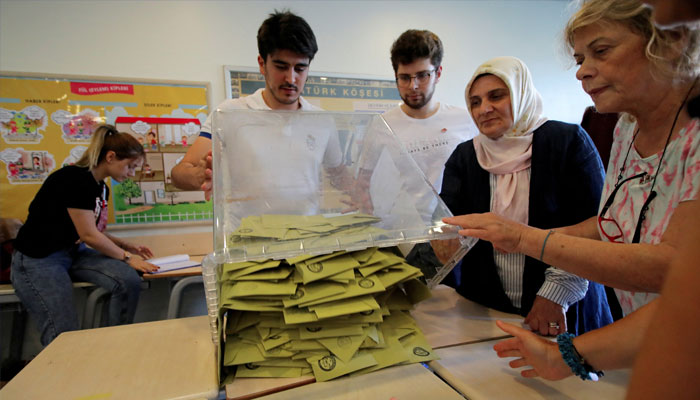
Voter turnout is falling around the world and election results are increasingly in doubt, according to a report on the state of democracy on Tuesday. AFP was mentioned.
Between 2008 and 2023, global voter turnout fell by 10 percentage points, from 65.2 to 55.5 percent, according to an annual report by the Stockholm-based intergovernmental organization International IDEA.
The problems that affect “young democracies” also affect “extremely very old and established democracies” in Europe and the Americas, Kevin Casas-Zamora, Secretary General of IDEA International.
Of the 173 countries covered by the think-tank, nearly half of them also show “a very serious decline in at least one critical element of democracy,” such as the ability to hold credible elections or freedom of the press, Casas-Zamora added. .
In the United States, three indicators have declined since 2015: credible elections, civil liberties and political equality, according to the report.
Additionally, less than half of the US population (47 percent) believes the 2020 election was “free and fair,” according to a study released by IDEA in April — before the July assassination attempt on former president and US presidential candidate Donald Attu.
Cynical efforts
In addition to polarization, the United States also faces the challenge that much of its electorate does not consider election processes and results credible, Casas-Zamora noted, while resorting to political violence is seen as more legitimate.
On January 6, 2021, thousands of Donald Trump supporters stormed the US Capitol, galvanized by Trump’s refusal to recognize Joe Biden’s victory.
According to Casas-Zamora, casting doubt on “credible, robust electoral processes and results” is not limited to the United States.
When political leaders refuse to recognize the credibility of an election or take the initiative to challenge it in court, it “sends an important message to voters,” the report notes.
“In some cases, such signals convey legitimate concerns about an election; in others, they are cynical attempts to erode public faith in an opponent’s victory,” it said.
Between mid-2020 and mid-2024, the results of one in five elections were rejected by a losing candidate or party in the countries studied by IDEA, and opposition parties boycotted one in ten elections.
In Venezuela, opposition candidate Edmundo Gonzalez Urrutia contested the re-election of President Nicolas Maduro on July 28 — with Urrutia in exile in Spain since September 8.
Checks and balances
The election result was not recognized by the United States, the European Union and several Latin American countries — including some of Caracas’ historic allies.
“Everything I see tells me that Maduro has decided to turn Venezuela into North Korea if that’s what it takes to stay in power,” Casas-Zamora told AFP.
The report also points to a disappointing state of the world, where wars, global warming and social inequalities are fueling the erosion of democracies.
“I am sure that a fully democratic Russia would not have invaded Ukraine,” Casas-Zamora said.
“There would be enough checks and balances to prevent a war of aggression against Ukraine,” he continued.
The head of the think tank said he hoped “it will be understood that supporting democracy is a key element of any long-term, well-thought-out security strategy”.
Despite the bleak picture the report paints, there are hopes, according to Casas-Zamora, such as successful elections followed by peaceful transfers of power in Guatemala, India, Poland and Senegal.
Data for 2024, which IDEA has called an “electoral supercycle” year — where half the world’s population would have the chance to go to the polls — will be detailed in an upcoming report.
a href=”https://www.geo.tv/latest/564609-disputed-elections-becoming-a-global-phenomenon-report”>Source link


