

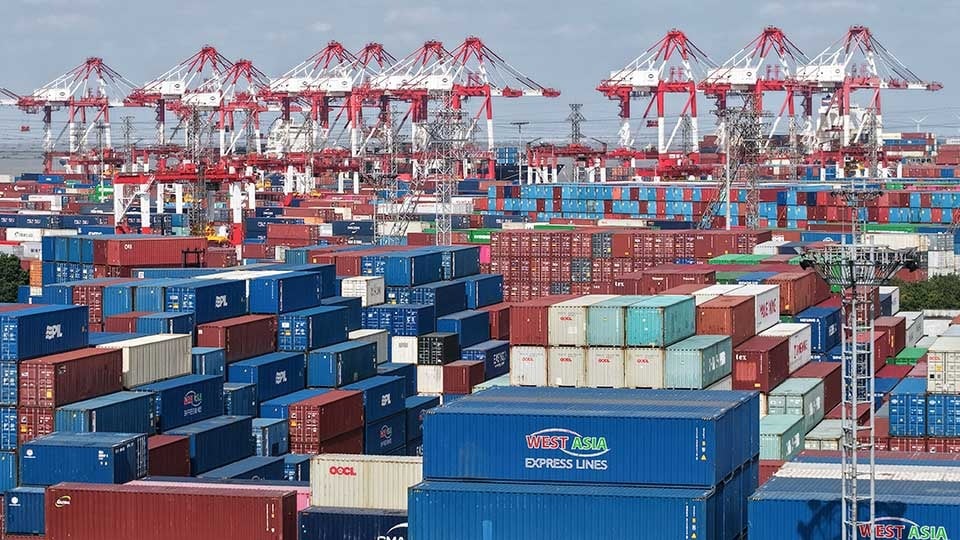
BEIJING: China’s towering annual trade surplus topped $1 trillion for the first time last month, data showed on Monday, as a sharp drop in shipments to the United States was offset by a rise in exports to other major markets.
Presidents Xi Jinping and Donald Trump reached a tentative truce in their fierce trade war when they met in late October, agreeing a pause in painful measures that included steep tariffs.
Exports have served as a key economic lifeline for China as trade and relations with the United States and other countries have fluctuated in recent years.
That has helped ease a lingering debt crisis in the country’s massive real estate sector and subdued domestic spending, which have weighed on growth and are among the most pressing issues facing Beijing.
Exports rose 5.9 percent year-on-year in November, reversing a slight decline recorded in October, the General Administration of Customs said.
The reading was also above a Bloomberg 4% growth forecast.
The jump came despite a continued slump in shipments to the United States, which fell 28.6 percent to $33.8 billion in November, the data showed.
“Weakness in exports to the United States was more than offset by shipments to other markets,” Zichun Huang of Capital Economics wrote in a note.
“Exports are likely to remain resilient, thanks to changing trade and increasing price competitiveness, as deflation pushes down China’s real real exchange rate,” Huang said.
The increase in shipments last month added to the country’s growing annual trade surplus for the first 11 months of the year, which Customs data showed reached $1.08 trillion in November.
“China’s trade surplus this year has already exceeded last year’s level, and we expect it to widen further next year,” Huang wrote.
However, the imbalance has long been a sticking point for major Western trading partners.
French President Emmanuel Macron threatened in statements published on Sunday that he would impose tariffs on China if Beijing failed to reduce its huge trade surplus with the European Union.
Macron — who completed a state visit to China last week — warned in business newspaper Les Echos that “Europeans will be forced to take strong measures in the coming months.”
In a further sign of China’s weak domestic consumption, data showed on Monday that imports rose 1.9% year-on-year in November — slower than the 3% increase forecast by Bloomberg.
“The rebound in export growth in November is helping to moderate weak domestic demand,” Zhiwei Zhang, president and chief economist at Pinpoint Asset Management, wrote in a note.
“Economic momentum slowed in the fourth quarter, in part due to continued weakness in the real estate sector,” he said.
Xi and Trump agreed at their October meeting in South Korea to reduce exorbitant tariffs on each other’s goods and extreme export controls that had shocked global industries.
The recession is due to end at the end of next year, giving officials time to reach a permanent deal – although experts warn such a breakthrough will be challenging.
“There is no guarantee that this uneasy truce will last that long,” Lynn Song, ING’s chief economist for Greater China, said last week.
“Much needs to go right to sustain the deal for the full year,” he wrote, adding that “it seems prudent to expect a softer external demand environment for next year.”
China’s leaders — who are aiming for overall growth this year of 5 percent — are expected to convene a key meeting this week focused on economic planning.
a href=”https://www.geo.tv/latest/638062-chinas-trade-surplus-tops-1tr-despite-plunge-in-us-bound-exports”>Source link



