

PUBLISHED December 14, 2025
KARACHI:
Al Pacino may be one of the most popular actors on the planet, but there’s a lot more to the man who shaped some of cinema’s most iconic characters. In his memoirs Sonny BoyPacino finally sheds the privacy he’s protected for decades—even as fame follows him everywhere afterward The Godfather. The book offers a mix of honesty, reflection and a personal story that fans have been waiting years to read.
In many ways, Sonny Boy it looks like an Al Pacino movie on paper. The story begins in the South Bronx and reaches Hollywood royalty. Most of the memoir focuses on his early struggles, and that alone makes it worth reading. For years, Pacino’s personal life and creative process remained a mystery. This autobiography breaks that pattern, taking readers behind the scenes of the performances that shaped his long career.
If you didn’t know during The GodfatherPacino couldn’t drive, couldn’t speak Italian, couldn’t dance, and faced constant pressure from the studio for being “too unknown,” then this memoir will blow your mind. He explains how his tough upbringing meant he would miss out on many things his friends took for granted. His parents divorced when he was two, his grandparents raised him while his mother worked to survive, and he dropped out of school before losing her in his twenties — a loss he still describes as devastating.
Pacino also shares details about his method acting, shaped by years in the theater and mentors like Lee Strasberg, who pushed him to explore the Method style that later defined him. Few know that Pacino wrote and directed documentaries and even directed a few feature films, or that he once went bankrupt despite his fame. The book sheds light on these lesser-known chapters with surprising openness.
As the memoir progresses, Pacino spends less time on movies and more on his personal interests and concerns. While this change may seem slow to some readers, his stories of first meeting Dustin Hoffman, Martin Sheen and Robert De Niro are delightful. One anecdote describes how he and De Niro lived separately in New York for years, but somehow didn’t cross paths until much later.
Before starring in classics like The Godfather, Serpico, and Dog day afternoon in the 1970s and Women’s Perfume, Carlito’s Way, and Heat In the 1990s, Pacino was part of a small neighborhood gang where he briefly experimented with drugs and alcohol. His mother, like many strict parents of the 1950s and 1960s, did not allow him to go out after sundown, which sparked a rebellious streak he now regrets. Ironically, that same spirit helped him channel raw energy on stage. At one point he was called “the next Marlon Brando” — a comparison that thrilled and scared him, not least because he later starred opposite Brando in his film.
Pacino was a latecomer to the movies and landed The Godfather at 32 — late by Hollywood standards. He explains how studio executives pushed for a taller, more famous actor and how director Francis Ford Coppola fought to keep him. He names many friends and teachers who helped him climb before forty, and admits he’s survived more “lows than highs,” yet he’s never let setbacks erase his ambitions.
Two of his deepest regrets, he writes, were relying too much on a business manager to handle his finances and his long struggle to quit drinking, which nearly destroyed his career. He also pays close attention to how he developed the energy behind his iconic lines and shares stories about the relationships he’s had over the years — many of which have been strained by his intense commitment to acting.
The memoir includes personal photos from his childhood, stage years and later film sets, giving fans a visual timeline of his life. Sonny Boy strays from time to time, like Pacino’s unpredictable filmography, especially when it goes into long-winded, philosophical reflections on fame and loneliness. Yet even these detours show a side of Pacino that rarely comes out in interviews.
One of the book’s strongest points is Pacino’s look back at the roles he turned down, some because he didn’t feel ready, others because he didn’t understand the scripts at the time. He admits to giving a few films that later became big hits, but says he’s never regretted choosing roles “that scared him” because that fear pushed him to grow as an actor. This honesty gives the memoir a refreshing, human touch.
Another standout section explores how Pacino approaches failure. He talks about miscasts, forgotten films and moments when he felt his career slipping away. Instead of avoiding these topics, he leans into them, sharing what each setback has taught him. His reflections on rebuilding trust, especially in the early 1980s when roles dried up, are some of the most inspiring pages in the memoir.
In the end, Sonny Boy it works because Pacino writes the same way he acts—with intensity, humor, sensitivity, and a deep respect for the craft. Even when the story wanders, the voice behind it remains warm and sincere. For anyone interested in the man behind the iconic roles, this autobiography offers a rich, revealing look at a Hollywood legend.
A legacy worth celebrating
More than an actor who clawed his way into Hollywood, Pacino is a full-fledged American legend—a story of an outsider who didn’t just enter the gates of an exclusive world, but remade the place in his own image. Before Pacino arrived, the actors who dominated the industry were classic Hollywood alphas: tall, well-polished and blue-eyed men who fit an established mold. Pacino didn’t fit into anything. Born in the Bronx to working-class parents, he lacked connections, a safety net, and a road map. What he had was hunger—the kind that lights fires.
In his early years, Pacino wasn’t the man people lined up to watch. he was the one ripping up their tickets. As a part-time usher in a small New York theater, he saw audiences flocking to see other performers command the stage. Years later, the same crowds would pay to see him. This arc from usher to thespian is more than poetic. It is the design of a man who started from the bottom and reached the top through hard work.
Before The Godfather, Pacino was just a name. Even director Francis Ford Coppola had to fight the studio for him. He was too short, they said. Too ethnic. Not charismatic enough. Wrong type of male. Hollywood wanted leading men who looked like they had descended from Olympus. Pacino looked like he just stepped off the subway. And yet, once it hit the screen, it soared. He wasn’t the blue-eyed archetype. he was the man who could become anyone—a trait far more destructive.
Then came Michael Corleone. A role that didn’t just announce Pacino—it launched him into the culture. His performance in The Godfather and The Godfather Part II remains one of cinema’s greatest studies in controlled tension: a quiet young man frozen by ruthless power. This job alone could ensure a lifetime of respectability. But Pacino didn’t make it.
During the 1970s, he did a streak that few actors have equaled: Serpico. Dog day afternoon. …And Justice for All. Rough. Political. Electric. These were characters born from the streets of New York that he knew pushed aside flawed men, men who vibrated with moral conflicts and survival instincts. In a decade defined by anti-heroes, Pacino became the benchmark.
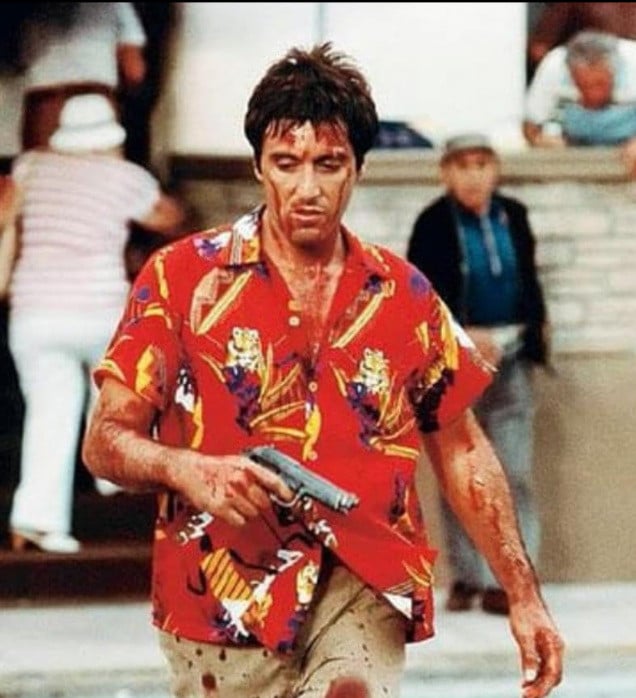
The 1980s brought a new wave of actors, a new tide of heartthrobs with the fresh sparkle of Hollywood youth: Tom Cruise, Rob Lowe. Pacino faced Tony Montana in Scarface, a performance so grand, so operatic, so volcanic, that it transcended the decade itself. Tony Montana wasn’t just a character. it was a cultural lightning bolt. Decades later, his lines still resonate in hip-hop lyrics, posters, memes and dorm room walls. Pacino has proven, once again, that when the spotlight shifts, he doesn’t chase it – he takes it back.
But the 1990s sealed his legend. Frankie and Johnny. Carlito’s Way. Heat. Donnie Brasco. The Devil’s Advocate. Any Sunday. A decade of roles that showed what range looks like when stretched to its outer limit. And at the center of it, the performance that eventually won him an Oscar: Lt. Col. Frank Slade in Scent of a Woman. Strong, shattered, theatrical and deeply human – the type of role that only Pacino could pull off.
But what’s remarkable—and rarely said—is how often Pacino stumbled. His career took off. He chose films that didn’t land. Critics wrote him off more than once. However, each time he came back stronger. This resilience was not magical. It was tenacity learned in the Bronx, forged in the theater, fought for everything. Pacino was not afraid of dark alleys. He grew up in them. And whenever his career wandered there, he found his way back into the bright lights.
Even past the age of 60, when most actors tend to slow down, Pacino kept pushing. He played a corrupt detective opposite Robin Williams in Insomnia — cold, coiled. He was a manipulative mentor in The Recruit, an unexpectedly stylish reinvention that left audiences reeling. He reunited with Robert De Niro in Righteous Kill, and then again in The Irishman — released on a streaming platform, an idea unthinkable when Pacino started in an era of big-screen cultism.
Along the way, he directed and produced films and documentaries, but is not known for his work behind the camera. He is famous for being the kind of actor who sets the bar for everyone else. Even in his failures, there’s a fearlessness that most artists spend their careers trying to find.
Al Pacino may not be the kind of busy actor he was in his youth, but when he’s on screen, he still packs a punch. Whether he’s playing a revenge-driven Nazi hunter in Amazon’s Hunters or taking on Shylock in The Merchant of Venice, Pacino continues to surprise his audiences by embracing challenging material rather than relaxing into composition.
Pacino’s story is not one of success alone, but one of defiance, of building a career not on looks, not on pedigree, but on acting that transcends decades. He proved that greatness doesn’t require perfection, only the courage to get up, fall and get back up again. And that’s why Al Pacino’s legacy endures. It is something worth enjoying.
Omair Alavi is a freelance contributor who writes about film, television and popular culture
All facts and information are the sole responsibility of the author
a href=”https://tribune.com.pk/story/2582051/a-memoir-of-grit-and-genius”>Source link


